
What is a California Anger Management Enrollment Certificate and How Do I Get One?

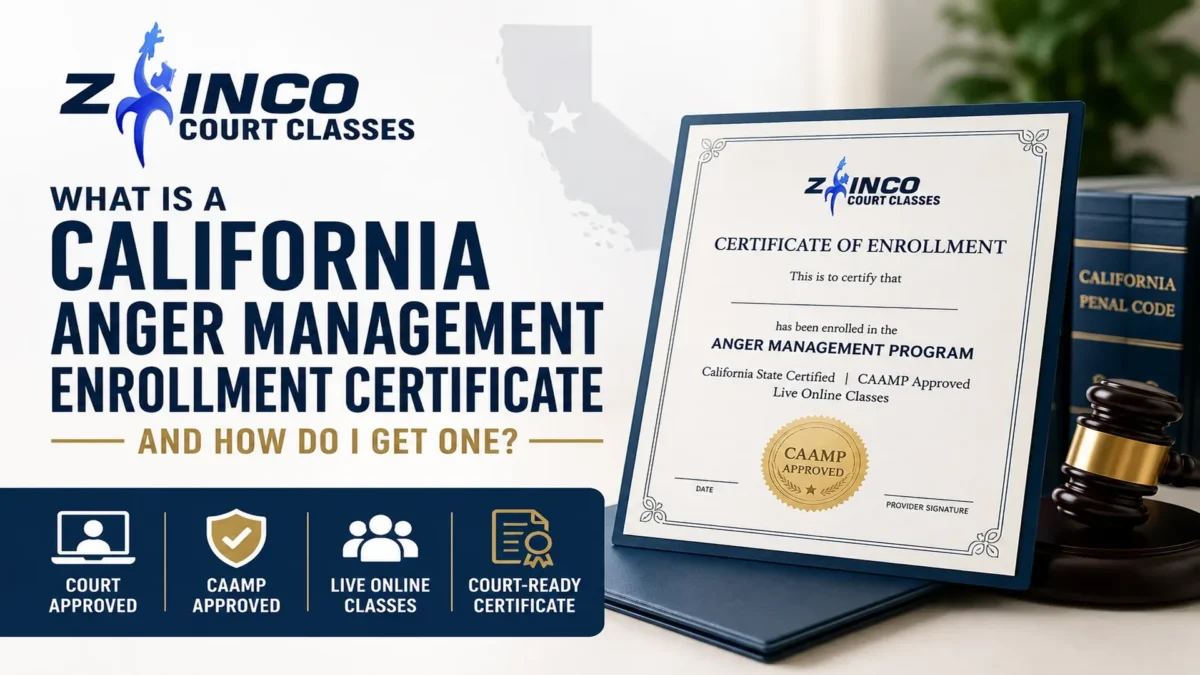
A California anger management certificate is a document a state-certified provider issues to prove you completed a court-approved anger management program. California courts, probation officers, employers, family-law judges, and licensing boards routinely require one after charges like misdemeanor battery, road rage, school discipline incidents, child custody disputes, or workplace conduct claims. To get one, you enroll with a provider listed on the California Association of Anger Management Providers (CAAMP) directory, complete the number of hours your court order specifies (most commonly 12 hours, 26 weeks, or 52 weeks), and receive a court-ready certificate of completion.
One critical detail most blog posts skip: a generic “anger management certificate” is not the same thing courts require for domestic violence cases. This guide covers both paths so you do not enroll in the wrong program and have your certificate rejected.
What a California Anger Management Certificate Actually Is
The certificate is a one-page document, signed by your provider, that lists your full legal name, the program name, the provider’s California state license number, your total hours of attendance, the dates of those classes, and the program’s credentialing body (almost always CAAMP). California does not run a single statewide registry of certificates — instead, courts generally look for certificates from providers with verifiable credentials, such as a CAAMP listing.
That is why selecting the right provider matters more than any other choice you will make in this process. A certificate from a non-credentialed provider, an out-of-state program, a self-paced online course with no live instructor, or a generic “online anger management class” can be rejected at your hearing — even if you completed every hour. Judges and probation officers know the format of legitimate California certificates, and they verify the issuing provider against the CAAMP directory.
If your paperwork says “anger management,” “anger control,” “impulse control therapy,” or “counseling for anger,” a CAAMP-credentialed certificate is the right document. If your paperwork specifically references California Penal Code 1203.097 or “batterers’ intervention,” you need a different program — covered next.
Anger Management vs. PC 1203.097 Batterers’ Intervention Program
This is the single biggest source of confusion in California courts, and the reason many participants finish a program only to have the court reject the certificate. California Penal Code 1203.097 specifically mandates a 52-week Batterers’ Intervention Program (BIP) for anyone convicted of an offense involving domestic violence against an intimate partner. A standard anger management class — even a 52-week one — will not satisfy a PC 1203.097 condition of probation.
The two programs have different curricula, different state oversight, and different certificates. BIP is a state-regulated, weekly group program that covers power and control dynamics, accountability, and the specific patterns of intimate partner violence. Standard anger management focuses on emotion regulation, cognitive-behavioral skills, and de-escalation — useful for most court orders, but not what PC 1203.097 requires.
Read your court paperwork carefully. If you see “PC 1203.097,” “domestic violence,” “DV class,” “batterers’ intervention,” or “BIP,” you need a 52-week BIP provider — not a generic anger management class. If your order does not mention domestic violence and instead references battery (PC 242), assault (PC 240), disturbing the peace (PC 415), road rage, child custody mediation, or employer-required counseling, a standard CAAMP-credentialed anger management certificate is what the court expects.
How Many Hours Will the Court Require?
California court orders fall into three common buckets. Most first-time misdemeanor cases — simple battery, disturbing the peace, fighting in public — receive a 12-hour anger management requirement, completed as twelve 1-hour live group classes. Family law judges, employers, and licensing boards often accept this same 12-hour completion. More serious or repeat offenses can carry a 26-week requirement, with one class per week. Anything tied to PC 1203.097, as covered above, carries a separate 52-week BIP requirement.
The single most important step you can take this week is to read your minute order or sentencing paperwork and identify the exact number of hours or weeks. If your paperwork is missing or unclear, call your attorney or the clerk’s office at the courthouse where you were sentenced — do not guess. Enrolling in a 12-hour program when the court ordered 26 weeks will fail your compliance check.
Once you know the requirement, confirm it with your intake clinician on day one. A reputable provider verifies your court order before charging you for classes and adjusts your program length to match the court’s order exactly.
Do California Courts Accept Online Anger Management Classes?
Since 2020, California courts and probation departments have broadly accepted live online anger management classes delivered via video conferencing (typically Zoom) with a licensed instructor. The legal standard is unchanged: the program must be state-certified, the provider must be CAAMP-credentialed, and the instruction must be live and interactive — not pre-recorded videos or self-paced modules. A live online class is treated the same as an in-person class.
What courts continue to reject are self-paced web courses, watch-a-video programs, and certificates from out-of-state providers who are not registered with California. If a website lets you “finish in one day” by clicking through video lessons alone, that certificate will not hold up in a California courtroom. The shortcut is not worth the rejection.
Live online classes have practical advantages for participants who are working, raising kids, or living somewhere with limited in-person options. You join from home, work, or anywhere with reliable internet. Attendance is logged in real time and visible on the certificate. The court does not distinguish between someone who drove to an office and someone who joined the same instructor’s Zoom session.
How to Choose a Court-Approved Provider in California
Three things separate a legitimate California provider from a program that will get your certificate rejected. First, state certification and a CAAMP credential — ask for the provider’s California license number and verify them on the CAAMP directory before you pay anything. Second, live instructor-led classes with real-time attendance logging, not recorded videos. Third, transparent pricing with no surprise certificate fees, book fees, or “rush processing” charges at the end.
You should also be able to get a same-day proof of enrollment document to email to your attorney or probation officer before your hearing. This is standard at credentialed providers and is often what keeps a participant out of contempt while they complete their hours over the coming weeks. Ask about it during intake. [INTERNAL LINK: how to enroll fast before a court date]
Avoid providers who pressure you to enroll without seeing your court paperwork, do not list their California license number publicly, or sell certificates as a standalone product without the actual class hours. These programs do not survive court verification.
What County You’re In Matters (a Little)
California is a county-administered court system, and individual probation departments occasionally have their own list of preferred providers. Los Angeles County, Orange County, San Diego County, Riverside County, San Bernardino County, Sacramento County, and the San Francisco Bay Area courts all accept CAAMP-credentialed certificates as the baseline. Some probation officers maintain a shorter approved list and may ask you to use a provider from it. [INTERNAL LINK: county-by-county acceptance]
If your probation officer hands you a list, use it. If you were not given a list, ask the officer directly: “Does your office require a specific provider, or will any CAAMP-credentialed program work?” Most will accept any credentialed provider. The few that have a stricter list are usually upfront about it.
Frequently Asked Questions
Do courts accept online anger management classes?
Yes — California courts widely accept live online anger management classes from state-certified, CAAMP-credentialed providers. The class must be live and instructor-led via video conferencing (typically Zoom), with attendance logged in real time. Self-paced video-only courses, watch-and-click certificates, and out-of-state programs are routinely rejected.
What is the difference between anger management and a PC 1203.097 BIP?
PC 1203.097 is a domestic violence statute that mandates a state-regulated 52-week Batterers’ Intervention Program (BIP). Standard anger management classes — 12-hour, 26-week, or 52-week — do not satisfy PC 1203.097. If your court order references domestic violence or PC 1203.097, you must enroll in a BIP, not a generic anger management program.
How many hours of anger management does the court usually require?
Most first-time misdemeanor anger orders are 12 hours, completed as twelve 1-hour live classes. More serious offenses or repeat cases can require 26 weeks or 52 weeks. Read your minute order to find the exact requirement, and confirm it with your provider at intake before paying for classes.
How much does a California anger management certificate cost?
A standard 12-hour program in California typically runs $300 to $600 total, depending on the provider. Look for transparent pricing: a one-time intake fee plus a flat per-class rate, with the certificate and materials included. Avoid programs that surprise you with a separate certificate fee at the end.
How fast can I get my certificate?
Same-day proof of enrollment is standard at credentialed providers and is usually enough for an upcoming hearing or probation check-in. The final completion certificate is issued within 48 hours of your last class. A 12-hour program can be completed in as little as 2-3 weeks if you attend multiple classes per week.
Enroll with Zinco Court Classes
Zinco Court Classes is a California State Certified anger management provider (CAAMP Provider ID: CA-AM-2024), CAAMP Approved, and aligned with common California court expectations. Our court-ready certificates are accepted by California Superior Courts and probation departments statewide. Programs are 100% live online via Zoom with licensed instructors — no pre-recorded videos, no self-paced shortcuts that get rejected. Pricing is transparent: $70 one-time intake fee + $30 per 1-hour class, with materials and certificate included. Same-day proof of enrollment is available for upcoming court dates. Enroll now at app.zincocourtclasses.com/Enroll and receive your enrollment confirmation today.