
Anger Management vs. Domestic Violence (DV) Classes: What’s the Difference?

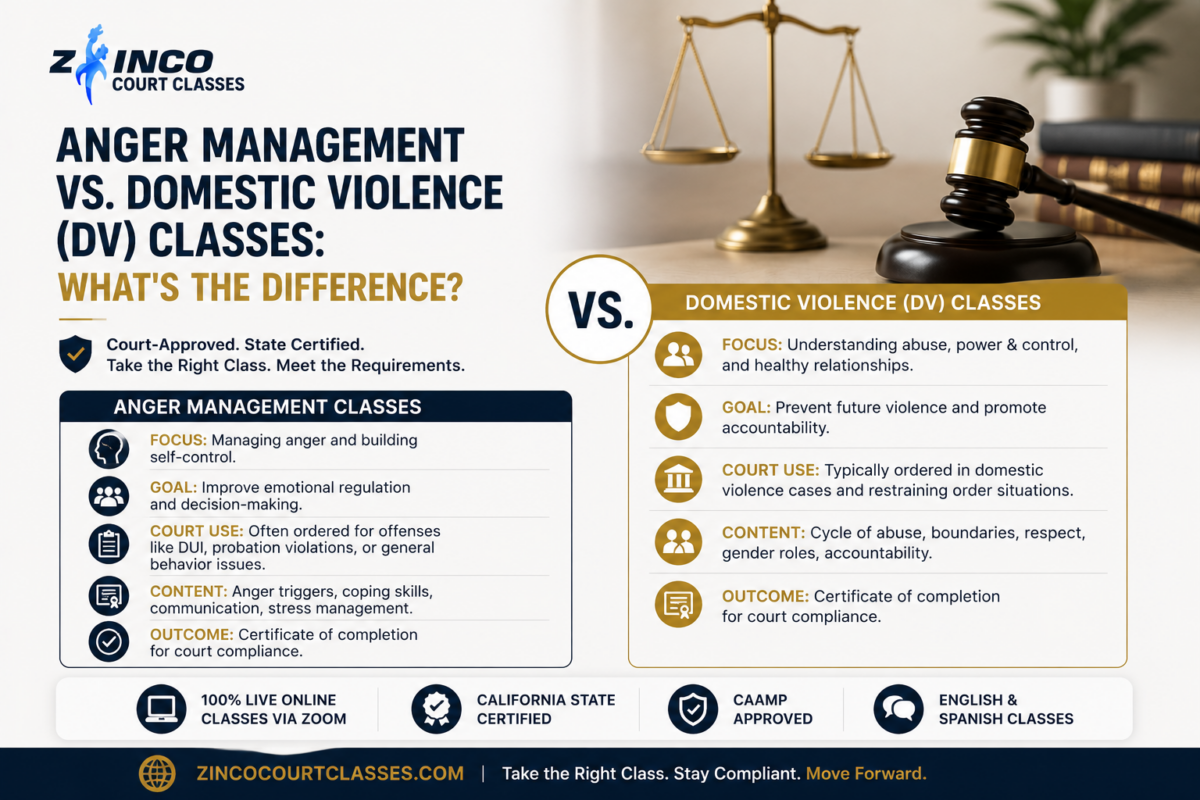
Anger management and domestic violence classes are two completely different court-mandated programs in California, and confusing them is the single most common reason participants finish a program only to have their certificate rejected. Anger management is a state-certified class covering emotion regulation, cognitive-behavioral skills, and de-escalation techniques — typically 12 hours, 26 weeks, or 52 weeks depending on the court order. Domestic violence classes, formally called Batterers’ Intervention Programs (BIP) under California Penal Code 1203.097, are state-regulated, 52-week programs focused specifically on intimate partner violence, power and control dynamics, and accountability. Complete the wrong one and the court rejects the certificate, even if you attended every session.
This guide explains exactly when each program applies, what the curriculum differences are, why the distinction matters legally, and how to know which one your court order actually requires.
The Legal Foundation: PC 1203.097 vs. Standard Anger Management
California Penal Code 1203.097 is the statute that governs domestic violence probation. When someone is convicted of a misdemeanor or felony that involves domestic violence — defined as abuse against a spouse, former spouse, cohabitant, dating partner, or the mother/father of the person’s child — PC 1203.097 mandates a highly structured 52-week Batterers’ Intervention Program as a condition of probation. This isn’t optional; it’s baked into the statute. Standard anger management classes, no matter how long, do not satisfy PC 1203.097.
Anger management, by contrast, is used for a much broader range of court orders where the court has determined that emotional regulation skills would benefit the defendant. Common triggers include misdemeanor battery (PC 242), assault (PC 240), disturbing the peace (PC 415), road rage, workplace altercations, school discipline referrals, family law disputes, and voluntary self-referrals. None of these fall under PC 1203.097.
Curriculum Differences: What You Actually Do in Each Program
Anger management classes focus on the cognitive and behavioral side of anger — recognizing triggers, physiological signs, thought patterns that escalate emotion, de-escalation techniques, communication skills, and stress management. The curriculum is drawn from cognitive-behavioral therapy (CBT) and covers universal skills applicable across many life contexts. Class format is typically live group instruction with a licensed clinician, homework assignments, and skill practice.
Batterers’ Intervention Programs cover fundamentally different material. BIP curriculum focuses on power and control dynamics within intimate partner relationships, the cycle of violence, accountability for behavior, impacts on victims and children, and understanding the specific patterns that distinguish intimate partner violence from other forms of conflict. The program is a full year of weekly two-hour sessions (104 hours total) and includes accountability assessments, victim contact restrictions, and periodic progress reports to probation. BIP is more intensive, more specific, and more clinically supervised than general anger management.
How to Know Which One Your Court Ordered
Your minute order, probation conditions document, or sentencing paperwork will use specific language. Words that point to BIP / DV classes: “PC 1203.097,” “batterers’ intervention program,” “BIP,” “domestic violence class,” “DV class,” “52-week batterers’ program,” or any reference to a spousal, dating, or intimate partner offense. Words that point to anger management: “anger management,” “anger control,” “impulse control therapy,” “counseling for anger,” “anger management class.”
If your paperwork is ambiguous — for example, “anger management class” but the underlying charge was a domestic dispute — call your attorney or the courthouse clerk before enrolling. The stakes are too high to guess. Some courts use loose language even when they mean BIP.
What Happens If You Enroll in the Wrong Program
Completing a 12-hour anger management program when the court ordered a 52-week BIP means starting over from scratch after the court rejects your certificate. Best case, you lose the money spent on the wrong program and add 12 months to your compliance timeline. Worst case, the missed deadline triggers a probation violation, a bench warrant, or additional jail time. The court does not accept “I misunderstood the requirement” as a defense — the paperwork you signed at sentencing established the requirement in your name.
The reverse — enrolling in a BIP when the court only ordered anger management — is less catastrophic (the more rigorous program will usually satisfy the lesser requirement), but it wastes months of your time and thousands in fees. Get the right program the first time by confirming with your attorney or provider before enrolling.
Cost and Time Comparison
Anger management is faster and cheaper. A 12-hour program in California typically costs $300 to $500 total (at Zinco: $70 intake + 12 classes × $30 = $430) and can be completed in 2-4 weeks by attending multiple sessions per week. A 26-week program runs $70 intake + 26 × $30 = $850. A 52-week anger management program (rare) runs $70 intake + 52 × $30 = $1,630.
BIP costs are set by the state and typically run $50-$70 per weekly session over 52 weeks = $2,600-$3,640 total, plus intake and assessment fees. BIP takes a mandatory full year — you cannot accelerate it by attending multiple sessions per week. The 52-week timeline is part of the therapeutic design and is enforced.
Frequently Asked Questions
Can I take anger management instead of DV classes if the charge was minor?
Only if the court order specifies anger management, not PC 1203.097 BIP. Courts sometimes allow anger management for very minor domestic disputes charged as disturbing the peace or misdemeanor battery — but only when the paperwork actually says “anger management,” not when it references PC 1203.097 or “batterers’ intervention.” Read your order carefully.
Does completing anger management help if I’m later charged with DV?
It doesn’t satisfy a future PC 1203.097 requirement — you’d still need to complete the full 52-week BIP. But a completed anger management certificate can be presented to your attorney as evidence of proactive rehabilitation, which sometimes influences plea negotiations or sentencing.
What if the underlying charge involves a partner but was reduced?
If the court explicitly reduced the charge and removed PC 1203.097 from the conditions, anger management may suffice. If the plea reduced the charge but left PC 1203.097 in the probation conditions, BIP still applies. The controlling document is your current probation conditions, not the original charge.
Are BIP programs available online?
California is more restrictive with BIP online delivery than with anger management. Some counties allow live online BIP via video conferencing; others still require in-person attendance. Check with your probation officer and BIP provider before enrolling in an online program.
Can Zinco Court Classes handle both anger management and BIP?
Zinco Court Classes is state-certified for anger management (CAAMP Provider ID: CA-AM-2024, CAAMP Approved). BIP requires separate state certification under PC 1203.097. Confirm your court order language before enrolling — if it references BIP, we’ll help you find an appropriate BIP provider.

Enroll with Zinco Court Classes
Zinco Court Classes is a California State Certified (CAAMP Provider ID: CA-AM-2024), CAAMP Approved anger management provider. Programs are 100% live online Zoom classes with licensed instructors — used by participants across California for court-ordered anger management — not PC 1203.097 BIP; acceptance always depends on your specific order. Transparent pricing: $70 intake + $30 per 1-hour group class or $99 per private 1-on-1 session. Same-day proof of enrollment for upcoming hearings. Enroll at app.zincocourtclasses.com/Enroll.